- Document ID: 138760221
- Document Collection: 7-2-1-5_Briefe von Zwangsarbeitern und Zwangsarbeiterinnen
?
recipient:
Jurko KUTSCHERUK
„Schiwotowka, Oratowo“
There doesn’t seem to be a sender`s name or address.
But maybe there are notes in Cyrillic somewhere that would help identify the sender? - @mally
I already had two cards sent to the same recipient, written by Maria and Natalija KUTSCHERUK - see here.
(To me the handwritings in the text fields of these 3 cards look kind of different, but I’m not sure..)
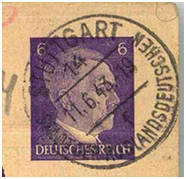
postal stamp: I entered „unclear“ in „place“
Could it be „Stuttgart“? like in the card by Natalija?
I actually had a few cards without sender. I assume in some cases the sender’s address might be on the back of the card.
And „Stadt der Auslandsdeutschen“ is indeed Stuttgart: https://de.wikipedia.org/wiki/Stadt-Ehrentitel_der_NS-Zeit#Offiziell_verliehene_Titel
Vielen Dank, @t-m , für diesen Hinweis und die weiterführenden links!
Den unteren Teil des Stempels hatte ich nur teilweise entziffern können.
(Scheinbar gibt es immer noch Abartigkeiten, auf die ich erst mal gar nicht gekommen wäre….„Stadt der Zwangsarbeitslager“ hätte eher gepasst)
Wünsche dir einen guten  tag!
tag!
The Cyrillic text shows the name of the recipient: Юрко Кучерук (Jurko Kutscheruk).
She writes to her mother, father, Kolja (either her brother or possibly the nephew Mikola, Микола, who is mentioned by Marija Kutscheruk — this is only speculation, as the name is very common),
sister Ira, and niece Ninka (Nina).
Marija Kutscheruk – here –
writes to her sister, brother, and nephew Mikola (Микола).
All three senders at some point use the wording “we/us,” which could be a hint that they are not alone but with relatives. However, it could also be a stylistic choice, as in “we, the girls” or “we, the workers,” so it is hard to tell.
Dir auch vielen Dank, @mally !
Es ist gut, sprachliche Vermittler wie dich bei Bedarf mal fragen zu können. Das bringt mir die ukrainischen Zwangsarbeiter/innen menschlich ein wenig näher.
VG und eine gute neue Woche!
danke, es freut mich sehr, wenn ich auf diese Weise ein Stück Nähe zu den Geschichten der ukrainischen Zwangsarbeiter*innen vermitteln darf. Ich lerne selbst extrem dazu durch den workflow.
Schöne Woche!
In this case, I think it’s possible that the postcard has no sender. It seems to be handmade — just a lined piece of thick paper — and not a standard printed form for forced labourers. The post stamp is also glued on, not printed. So, the speculation could be that specially printed postcards were only available at a rate of two per month, but such a handmade form could be a grey area. If someone could acquire post stamps, it might have been possible to send an extra postcard. If this is not the first postcard, then the relatives already know who it is from, so they skipped writing the sender’s address.
read about this case here:
Illegale Beschaffung von Briefpapier und Transport der Briefe von Zwangsarbeitern durch deutsche Arbeitskollegen. Bekanntmachung der Firma J. P. Sauer u. Sohn Suhl.
here p.265
Wow, thank you so much!